First Coaching Session – €30 (one-time offer)



How an abusive person reacts: attack, control, and devaluation
RELATIONSHIPS & PSYCHOLOGY
Ioana Coman
5/1/20262 min read
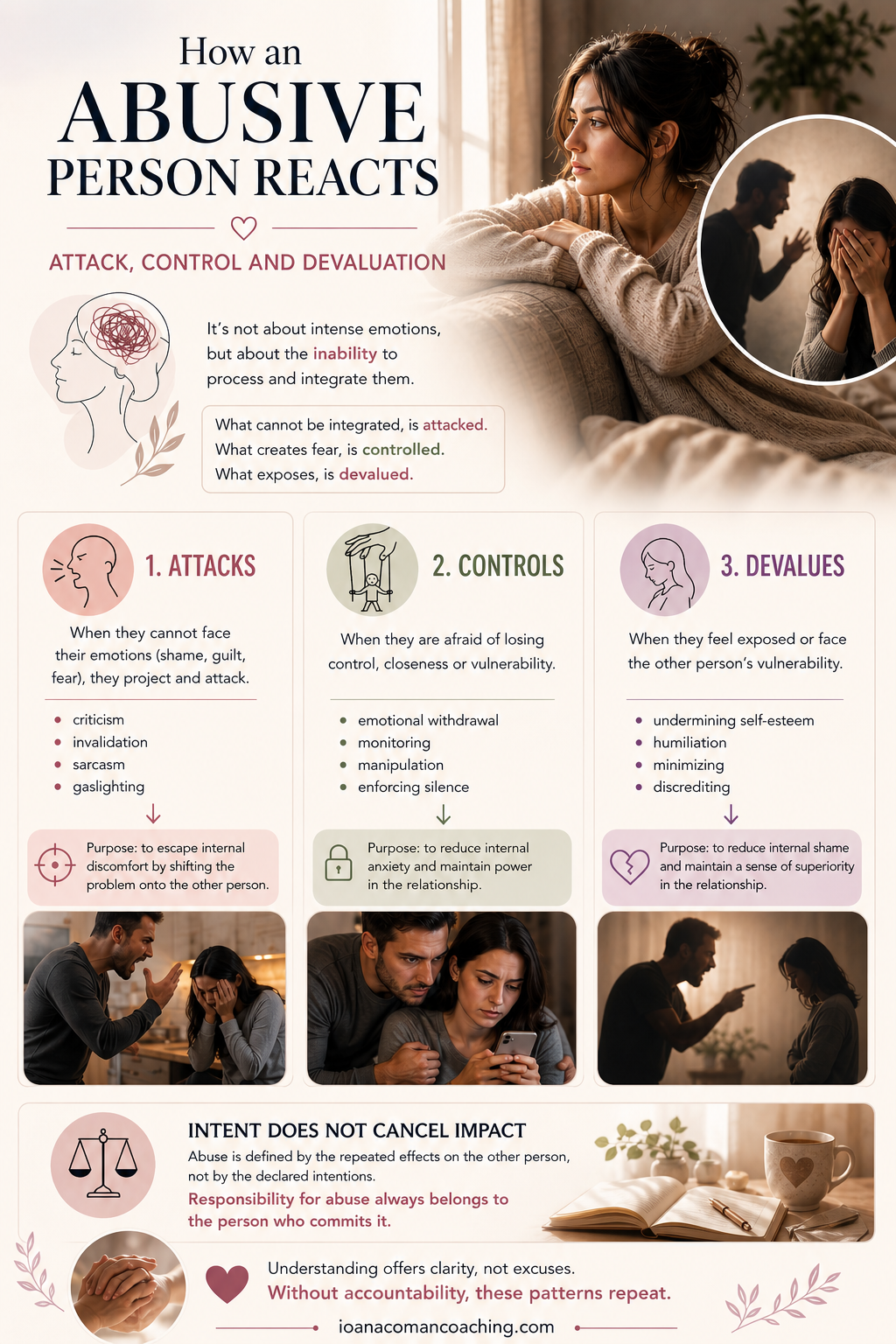
Abusive behavior does not arise from an excess of emotion, but from the inability to process it. From a psychological perspective, an abusive person does not react to the relational reality itself, but to the internal discomfort that this reality activates. When emotions, responsibility, or vulnerability cannot be integrated, they are externalized in the form of attack, control, or devaluation.
This mechanism can be captured in a simple yet deeply explanatory formulation: what cannot be integrated is attacked; what creates fear is controlled or destroyed; what exposes is devalued.
Emotional integration involves the ability to recognize an emotion, tolerate its discomfort, and reflect on one’s own role within the relationship. Research from attachment theory, initiated by John Bowlby, shows that when emotions are not met with availability and safety in childhood, individuals do not develop internal regulation mechanisms, but rather defensive strategies. Difficult emotions such as shame, guilt, or fear are later experienced as threats to the self.
In the absence of integration, the emotion is not processed, but projected. This is where attack emerges. Psychological attack—through criticism, invalidation, sarcasm, or gaslighting—is not a reaction to the partner’s behavior, but an attempt to move internal discomfort outward. Studies on emotional abuse published in Journal of Interpersonal Violence describe this pattern as a defensive mechanism aimed at reducing internal tension by discrediting the other person.
Fear plays a central role in abusive dynamics, but it is not fear of real danger. It is the fear of losing control, of emotional dependence, or of exposure. From a neurobiological perspective, according to the polyvagal theory developed by Stephen Porges, a nervous system shaped in unpredictable environments may perceive closeness, calm, and intimacy as threats. In this context, control becomes a strategy for emotional regulation.
Control manifests through emotional withdrawal, monitoring, manipulation, or enforced silence. When control is no longer sufficient to regulate internal anxiety, symbolic or relational destruction appears: the partner’s self-esteem, the relationship itself, or their reputation. Literature on psychological violence consistently shows that these behaviors are not impulsive, but repetitive and functional in the short term for the one who uses them.
Vulnerability represents another critical point. For individuals with major difficulties in emotional regulation, vulnerability is associated with shame. Research on shame and defensive mechanisms, including the work of Brené Brown, shows that unprocessed shame is often transformed into hostility or contempt. When a partner expresses pain, asks for repair, or sets boundaries, the abusive person feels exposed and reacts through devaluation.
Devaluation—through messages that undermine the other person’s worth, competence, or autonomy—temporarily reduces internal shame, but produces severe psychological effects on the victim. Clinical studies show that prolonged exposure to devaluation is associated with anxiety, depression, and decreased self-esteem.
An essential aspect consistently emphasized in the literature is the distinction between intention and impact. Abuse is not defined by the declared intention of the person, but by the repeated impact on the other. Even in the absence of a conscious intention to harm, behaviors that attack, control, or devalue produce real and cumulative psychological damage.
Therefore, explaining these mechanisms is not an excuse. Understanding that a person attacks what they cannot integrate, controls what they fear, and devalues what exposes them provides clarity, not absolution of responsibility. Responsibility for abusive behavior always belongs to the one who enacts it.
Abuse is not the expression of intense emotions, but of a lack of emotional accountability. And without accountability, these patterns do not correct themselves—they repeat.


Ioana Coman Coaching
Sessions available online. For inquiries or to book a session, contact me at: ioanacomancoaching@yahoo.com
Follow Ioana Coman Coaching on Instagram: @ioanacomancoaching https://www.instagram.com/ioanacomancoaching/
Ioana Coman Coaching — founded by Ioana Elena Coman