First Coaching Session – €30 (one-time offer)



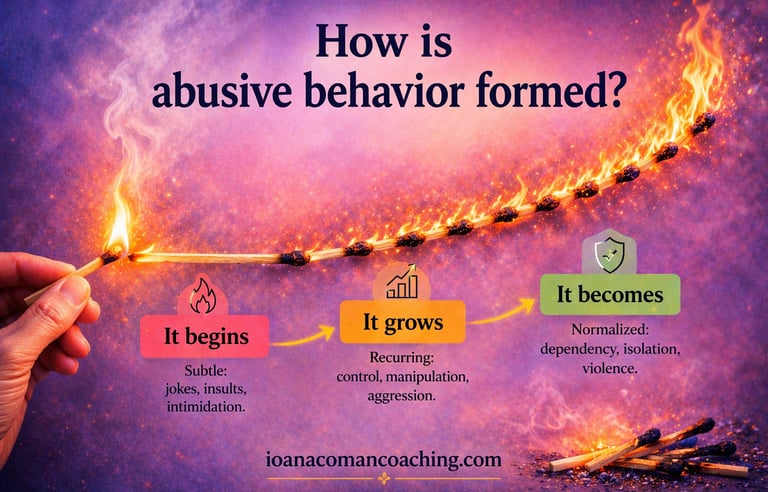
How is abusive behavior formed?
RELATIONSHIPS & PSYCHOLOGY
Ioana Coman
4/21/20263 min read
When emotions cannot be integrated
Emotional integration involves the ability to recognize an emotion, tolerate its discomfort, and reflect on its impact on others. When this capacity is lacking, difficult emotions are perceived as threats and are externalized. Research on emotional abuse published in the Journal of Interpersonal Violence shows that psychological attacks often appear as defensive mechanisms. Criticism, invalidation, or gaslighting are not reactions to relational reality, but attempts to move internal discomfort outward. This creates a consistent pattern: what a person cannot integrate emotionally becomes something they attack.
Fear, control and relational destruction
Fear plays a central role in abusive behavior, but it is not fear of real danger—it is fear of losing control, emotional dependency, or exposure. From a neurobiological perspective, according to polyvagal theory (Stephen Porges), a nervous system shaped in unpredictable environments may perceive closeness, calm, and intimacy as threats.In these conditions, control becomes a form of emotional regulation. Withdrawal, manipulation, enforced silence, or subtle threats temporarily reduce internal anxiety. When control is no longer sufficient, relational destruction appears: undermining the partner’s self-esteem, degrading the relationship or isolating the other person.
Shame and the mechanism of devaluation
Vulnerability is a critical point in abusive dynamics. For individuals with major difficulties in emotional regulation, vulnerability is associated with shame. Research on shame and defensive mechanisms, including the work of Brené Brown, shows that unprocessed shame is often transformed into hostility or contempt.
When a partner expresses pain, asks for repair, or sets boundaries, the abusive person feels exposed and reacts through devaluation. This temporarily reduces internal shame but produces severe psychological effects on the other person, being one of the most destructive forms of emotional abuse.
Attachment, personality traits and abusive behavior
Avoidant attachment, narcissistic traits, or psychopathic tendencies can increase the risk of abusive behavior, but they are not sole causes and are not sufficient explanations. Abuse is a behavior, not a label. Many people with avoidant attachment or narcissistic traits are not abusive, and many abusers do not meet clinical criteria for any personality disorder. The decisive difference is emotional responsibility.
Intention versus impact: the line that defines abuse
A key principle in relational psychology is the difference between explanation and justification. The fact that a person was hurt or shaped by their environment explains why certain behaviors appear, but does not excuse them. Abuse is defined by its repeated impact on another person, not by intention, past experiences, or psychological labels. Responsibility for behavior always belongs to the person who exercises it.
Many abusive behaviors are formed at the intersection of early wounds, enabling environments, and lack of emotional responsibility. A person does not need to be narcissistic, avoidant, or “mentally ill” to become abusive. It is enough for internal discomfort to be managed through attack, control, and devaluation, without accountability.Understanding these mechanisms brings clarity and prevention.But it does not remove responsibility.
Abusive behavior is often simplistically interpreted as the result of a “flawed personality,” narcissism, or avoidant attachment. In reality, research in relational psychology shows that much of emotional and psychological abuse is carried out by people without psychiatric diagnoses, but who have been shaped by early experiences and environments that normalized control, invalidation, and lack of emotional responsibility. This distinction is essential: explaining the mechanisms does not mean justifying the behavior. Responsibility for abuse always remains with the person who commits it.
Early wounds: the foundation of emotional vulnerability
Childhood experiences profoundly influence how a person regulates emotions and relationships. According to attachment theory (John Bowlby), children who grow up in environments where emotions are ignored, invalidated, or punished do not develop the ability to integrate them, but instead develop defensive survival strategies.
In such contexts, the child implicitly learns that vulnerability is dangerous, that mistakes lead to shame and that power or control provides safety. These learnings do not inevitably lead to abusive behavior, but they create a major vulnerability: difficulty tolerating emotions such as fear, shame, or helplessness.
The role of the environment: how abuse is learned and reinforced
Abuse does not arise only from personal wounds, but from what is allowed, normalized, or rewarded. People who grow up or live in environments where dominance is associated with power, control is confused with leadership, lack of empathy is seen as strength, and harmful behaviors have no real consequences, learn that these strategies are effective. From a behavioral perspective, any behavior that reduces internal anxiety and is not challenged or corrected tends to be repeated. In this way, abuse becomes a learned strategy, not an inevitable expression of a pathological structure.


Ioana Coman Coaching
Sessions available online. For inquiries or to book a session, contact me at: ioanacomancoaching@yahoo.com
Follow Ioana Coman Coaching on Instagram: @ioanacomancoaching https://www.instagram.com/ioanacomancoaching/
Ioana Coman Coaching — founded by Ioana Elena Coman