First Coaching Session – €30 (one-time offer)



Relationships are one of the fastest forms of personal growth
RELATIONSHIPS & PSYCHOLOGY
Ioana Coman
5/16/20263 min read
Why emotional closeness reveals parts of ourselves we cannot see alone
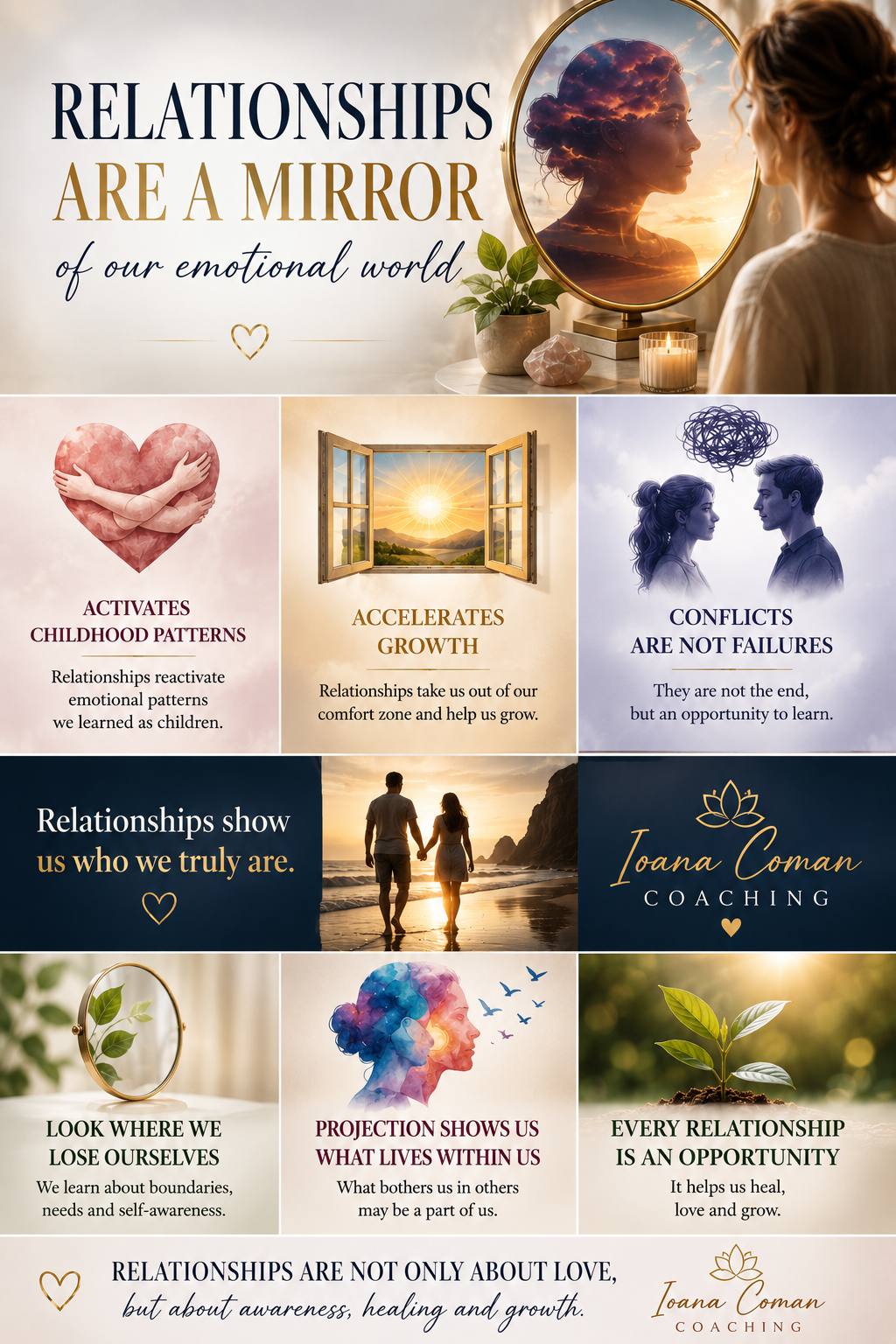
Relationships are one of the fastest and most intense spaces for personal development because they reveal parts of us that we often cannot see on our own. When we are alone, we may believe we are emotionally mature, calm, patient, self-aware, or fully healed. But relationships activate the exact emotional areas that remain sensitive beneath the surface: fear of abandonment, jealousy, the need for control, difficulty setting boundaries, or fear of emotional intimacy.
This is why relationships function like a psychological mirror. They do not simply provide love or connection. They show us very clearly how we react under emotional stress and who we become when vulnerability becomes real.
Attachment theory — relationships reactivate childhood patterns
Psychologists John Bowlby and Mary Ainsworth demonstrated that the way we received emotional safety in childhood strongly influences our adult relationships. The moment emotional closeness appears, the brain automatically reactivates old attachment patterns.
As a result, a person with anxious attachment may interpret emotional distance as rejection or abandonment, while a person with avoidant attachment may feel the urge to withdraw when intimacy becomes too emotionally intense. The relationship itself does not create these wounds. It simply activates them and makes them visible.
This is why many emotional reactions feel disproportionate. Sometimes we are not only reacting to the present moment, but also reliving older emotional experiences unconsciously triggered by the relationship.
Relationships accelerate personal growth
Psychologist Arthur Aron proposed that human beings have a natural need for growth and self-expansion. Relationships therefore become one of the fastest environments for psychological development. Emotional closeness exposes us to new perspectives, new emotional limits, and parts of ourselves we may never have discovered alone.
Sometimes relationships force us to communicate more honestly, manage conflict more effectively, or tolerate vulnerability without shutting down. Other times they force us to let go of old defense mechanisms that no longer work in authentic emotional connection.
This is why many people say that a relationship changed them deeply. Not because love destroys identity, but because emotional intimacy naturally creates adaptation and internal transformation.
Conflict is not automatically failure
Psychologist John Gottman demonstrated through decades of research that all couples experience conflict. The real difference is not whether conflict exists, but how it is handled.
Conflict reveals emotional maturity in a very direct way. During tense moments, we see how well we communicate without attacking, how quickly we become defensive, and how capable we are of repairing emotional ruptures after hurt or misunderstanding.
Many people believe healthy love means the absence of conflict. In reality, genuine closeness inevitably activates each person’s vulnerabilities. This is exactly why relationships can become such powerful spaces for emotional growth and self-regulation.
Relationships reveal where we lose ourselves
Family systems psychologist Murray Bowen introduced the concept of differentiation of self — the ability to remain emotionally connected to others without losing one’s own identity.
Relationships often reveal very clearly how well we set boundaries, how much we sacrifice ourselves for validation, and how comfortable we feel saying “no.” Many people only realize inside relationships that they avoid conflict out of fear, become emotionally dependent, or abandon their own needs in order to preserve connection.
In this way, relationships become the place where we most clearly observe the balance between love and self-respect.
Projection — what intensely triggers us often reflects something deeper inside us
Carl Jung described projection as the tendency to see in others parts of ourselves that we have not fully accepted or integrated.
This is why certain behaviors from a partner can trigger such intense emotional reactions. Criticism may activate shame or the need for validation. Emotional distance may reactivate fear of abandonment. Controlling behavior may expose our own insecurities or our deep need for safety.
This does not mean toxic behavior should be excused or tolerated. Some relationships are genuinely unhealthy and must be recognized clearly. But in many situations, our strongest emotional reactions are also revealing something important about our inner emotional world.
Emotional closeness exposes the truth about how we function
Solitude can bring temporary peace and emotional stability. But relationships reveal the truth about how we actually function emotionally.
They bring hidden fears, defense mechanisms, unmet needs, and emotional patterns to the surface. In relationships we see how we react when we are hurt, how well we communicate under stress, how much we can give without losing ourselves, and how much love we can receive without fear.
This is why relationships are one of the fastest and most intense spaces for personal growth. Not because they are always easy, but because emotional closeness has the power to reveal truths about ourselves that we may never have discovered alone.


Ioana Coman Coaching
Sessions available online. For inquiries or to book a session, contact me at: ioanacomancoaching@yahoo.com
Follow Ioana Coman Coaching on Instagram: @ioanacomancoaching https://www.instagram.com/ioanacomancoaching/
Ioana Coman Coaching — founded by Ioana Elena Coman