First Coaching Session – €30 (one-time offer)



Silence: The strongest boundary against manipulation
RELATIONSHIPS & PSYCHOLOGY
Ioana Coman
4/24/20262 min read
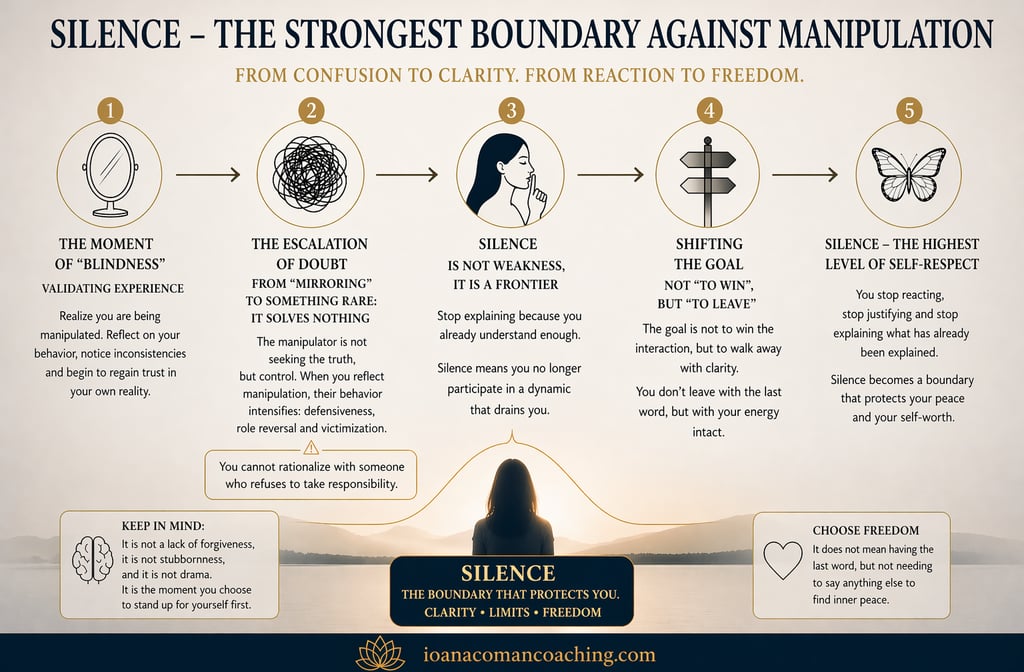
There comes a moment when confusion begins to unravel. Not suddenly, not dramatically, but gradually—when you start noticing that things no longer add up, that explanations stop making sense, and that you find yourself carrying guilt that isn’t yours. That’s where clarity begins.
Resisting manipulation is not a toxic reaction. It is not a lack of forgiveness, nor stubbornness. More often, it is the first sign that you are starting to see things as they truly are.
The moment you begin to see
When someone repeatedly distorts your reality, your natural response is to defend yourself. You feel the need to explain, to clarify, to put things back into order. You try to reconstruct the truth in a space where it is constantly being twisted.
At this stage, many people begin to mirror the behavior back. They notice inconsistencies, name them, and bring them forward. It is an important moment because, after a long period of doubt, you begin to trust your own perception again. But this stage, while necessary, does not solve the problem.
Why confrontation doesn’t work
It’s easy to believe that if you explain clearly enough, if you stay calm and logical, the other person will understand. The reality is that manipulation is not about misunderstanding—it is about control.
Someone who manipulates is not seeking truth, but maintaining a dynamic where they hold the advantage. The moment you begin to expose what is happening, you don’t create openness—you create resistance. The behavior becomes defensive, roles get reversed, and paradoxically, you end up being the one questioned.
This is not a failure of communication. It is a dynamic where logic changes nothing.
Silence as a boundary, not withdrawal
Here is where a difficult but essential shift happens. Sometimes, the healthiest thing you can do is to stop explaining. Not because you are wrong, and not because it doesn’t matter, but because you already understand enough. Continuing to explain does not bring clarity—it only drains your energy.
Silence, in this context, is not avoidance. It is a conscious choice to stop participating in a dynamic that exhausts you. It is the moment you withdraw your energy from a space where there is no reciprocity. Many people confuse silence with weakness. In reality, it is one of the most difficult forms of self-control. It requires letting go of the need to be understood by someone who has repeatedly chosen not to understand.
Shifting the goal
As long as you try to win the interaction, you remain trapped in it. In a dysfunctional relationship, winning does not mean resolution—it only prolongs the conflict.Real change happens when you shift your goal. You no longer want to prove, convince, or have the last word. You want to leave. And leaving does not happen through a stronger argument—it happens through clarity.
Silence as self-respect
Walking away from a manipulative dynamic is not running away. It is a conscious decision to stop negotiating with something that costs you too much.Silence becomes a boundary. You stop reacting to provocations, you stop justifying yourself, and you stop explaining things that have already been explained. Not because you have nothing to say, but because you have already said enough.
The quiet that remains is not emptiness. It is the space where you finally begin to hear yourself. And that is exactly where freedom begins.


Ioana Coman Coaching
Sessions available online. For inquiries or to book a session, contact me at: ioanacomancoaching@yahoo.com
Follow Ioana Coman Coaching on Instagram: @ioanacomancoaching https://www.instagram.com/ioanacomancoaching/
Ioana Coman Coaching — founded by Ioana Elena Coman