First Coaching Session – €30 (one-time offer)



The 4 stages of a failing relationship according to John Gottman
RELATIONSHIPS & PSYCHOLOGY
3/24/20265 min read
Introduction: Why Relationships Rarely Collapse Suddenly
Many people believe that relationships end because of a single dramatic event. However, decades of psychological research suggest something very different. Most relationships deteriorate gradually through a predictable pattern of interaction that unfolds over time.
One of the most influential researchers in the psychology of relationships, Dr. John Gottman, has spent more than forty years studying couples and their interactions. Through longitudinal studies conducted at the University of Washington, Gottman and his colleagues observed thousands of couples in what became known as the “Love Lab”, a laboratory where couples’ conversations, emotional responses, and physiological reactions were analyzed.
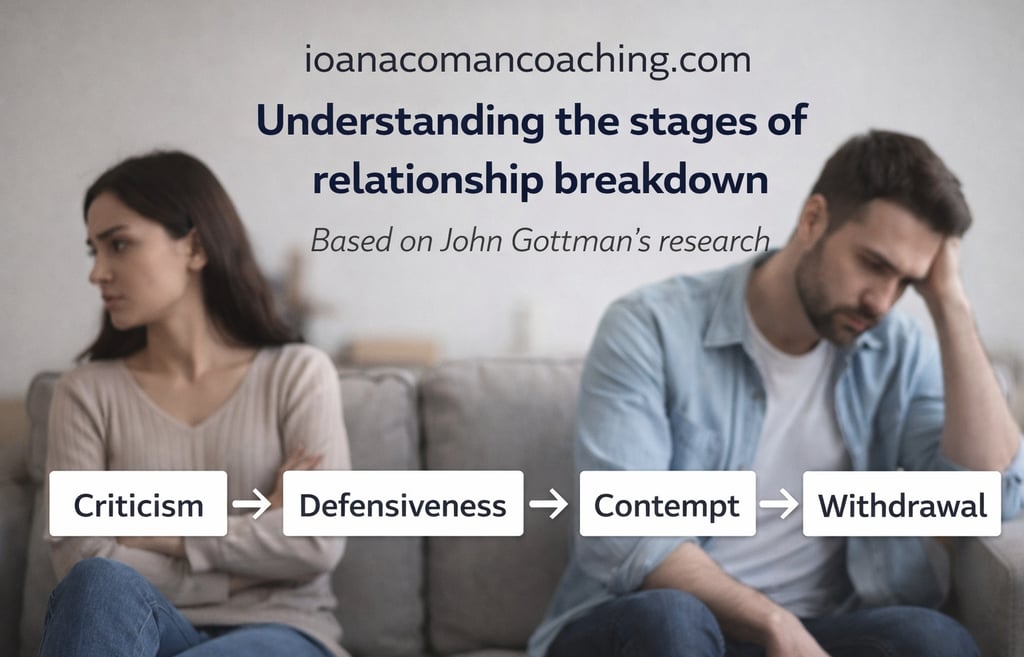
Based on these studies, Gottman identified a sequence of behaviors that often predicts the gradual erosion of relationships. These behaviors are sometimes referred to as the “Four Horsemen of the Apocalypse” of relationship breakdown. Understanding this sequence provides valuable insight into how conflicts escalate and why some relationships become emotionally exhausting over time.
Stage one: Persistent criticism
The first stage in the deterioration of many relationships begins with criticism. Criticism differs from healthy complaint. In a constructive relationship, partners can express dissatisfaction about specific behaviors without attacking the other person’s character. For example, someone might say, “It upset me when you forgot to call.”
Criticism, however, targets the person rather than the behavior. Instead of addressing a specific issue, it frames the problem as a flaw in the partner’s character. Statements such as “You never care about anyone but yourself” or “You always embarrass me” shift the conversation from problem-solving to personal attack.
Research by Gottman shows that persistent criticism creates an atmosphere of tension within the relationship. Over time, the partner who is repeatedly criticized begins to feel misunderstood, defensive, or emotionally unsafe. Even when positive experiences exist within the relationship, ongoing criticism slowly erodes emotional trust.
Criticism can also take subtle forms. Repeated remarks about physical appearance, sarcastic comments, comparisons with other people, or constant reproaches about small mistakes can accumulate and create a sense of ongoing judgment.
While relationships can still function at this stage, the emotional environment begins to change. Conversations become more tense, and partners may begin to anticipate conflict even during ordinary interactions.
Stage two: Defensiveness
As criticism becomes more frequent, the second stage often emerges: defensiveness. Defensiveness is a natural reaction to feeling attacked. When someone feels criticized or blamed, they may respond by protecting themselves rather than addressing the issue.
Defensive responses can include shifting blame, denying responsibility, or counterattacking with accusations of one's own. Instead of acknowledging the partner’s feelings, the conversation becomes a debate about who is right or wrong.
According to Gottman’s research, defensiveness prevents genuine communication from taking place. When both partners become defensive, conflicts remain unresolved because neither person feels heard. Over time, discussions that could have led to understanding turn into repetitive arguments where the same issues resurface without resolution.
Defensiveness also contributes to emotional exhaustion. When people feel that every conversation leads to conflict or justification, they may begin to withdraw emotionally or avoid difficult discussions altogether.
Stage three: Contempt
Among the four stages identified by Gottman, contempt is considered the most damaging and dangerous for relationship stability. Contempt emerges when one partner begins to view the other with a sense of superiority.
Contempt is often expressed through sarcasm, ridicule, mockery, eye-rolling, or openly humiliating comments. While criticism attacks behavior, contempt attacks the person’s worth or dignity. Statements that imply moral or intellectual superiority can deeply damage emotional connection.
In his research, Gottman found that contempt is the strongest predictor of relationship breakdown. Couples who regularly display contempt are significantly more likely to separate or divorce compared to couples who do not show this behavior.
Contempt also has physiological effects. Studies conducted in Gottman’s laboratory revealed that couples who express contempt during conflict often experience elevated stress responses, including increased heart rate and heightened emotional arousal. Over time, this creates an environment where partners feel unsafe and disconnected.
Once contempt becomes a regular part of interaction, rebuilding respect becomes extremely difficult.
Stage four: Withdrawal and emotional shutdown
The final stage in this sequence often involves withdrawal or emotional shutdown, a phenomenon Gottman describes as “stonewalling.” At this point, one partner may stop engaging in meaningful communication altogether.
Stonewalling occurs when someone becomes overwhelmed by conflict and emotionally shuts down in order to protect themselves. Instead of responding to the partner’s concerns, the person may avoid discussion, change the subject, or physically remove themselves from the interaction.
This stage typically appears after prolonged exposure to criticism, defensiveness, and contempt. When communication repeatedly fails to produce understanding, individuals may conclude that conversation is pointless.
Withdrawal often signals that the relationship has accumulated a high level of unresolved tension. At this point, emotional connection becomes extremely difficult to restore because both partners may feel deeply misunderstood or resentful.
Why relationships can feel confusing during this process
One reason relationship deterioration can be difficult to recognize is that these stages often coexist with positive experiences. Many relationships that follow this pattern still contain moments of affection, intimacy, shared activities, or emotional support.
This mixture of positive and negative experiences can create confusion. Partners may wonder how a relationship that includes genuine closeness can also contain intense conflict. However, psychological research suggests that the gradual erosion of respect and emotional safety often occurs alongside periods of connection.
The presence of positive moments does not necessarily prevent long-term damage if destructive communication patterns remain unresolved.
The importance of respect in long-term relationship stability
Across decades of research, Gottman’s work consistently highlights one central factor that determines the health of a relationship: mutual respect. Healthy relationships are not free of conflict. Disagreements are a natural part of any long-term partnership.
What distinguishes stable relationships from unstable ones is how partners handle these conflicts. When criticism escalates into defensiveness, contempt, and withdrawal, emotional safety gradually disappears.
Conversely, relationships remain resilient when partners can express concerns without attacking each other’s character, take responsibility for their mistakes, and maintain respect even during disagreements.
Recognizing the pattern
Understanding the stages of relationship deterioration can help individuals recognize unhealthy patterns earlier. Relationships rarely collapse overnight. Instead, they often follow a recognizable sequence where criticism leads to defensiveness, defensiveness evolves into contempt, and contempt eventually results in emotional withdrawal.
By recognizing these patterns, individuals can better understand the dynamics within their relationships and the importance of communication, accountability, and respect in maintaining emotional connection.
Decades of research from John Gottman and other relationship scientists demonstrate that while conflict is inevitable, the way partners handle conflict ultimately determines whether a relationship grows stronger or slowly breaks apart.
Recognizing these patterns is an important first step. But real change doesn’t come only from awareness — it comes from understanding how these dynamics show up in your own relationships and what keeps them in place.
If you find yourself caught in similar patterns and want clarity on what is happening in your situation, a 1:1 coaching session can offer a structured space to explore it. Together, we can identify the relational dynamics affecting you and the steps needed to rebuild emotional stability and connection.
You can schedule a 1:1 session here:
https://www.ioanacomancoaching.com/one-coaching-session-1


Ioana Coman Coaching
Sessions available online. For inquiries or to book a session, contact me at: ioanacomancoaching@yahoo.com
Follow Ioana Coman Coaching on Instagram: @ioanacomancoaching https://www.instagram.com/ioanacomancoaching/
Ioana Coman Coaching — founded by Ioana Elena Coman