First Coaching Session – €30 (one-time offer)



The secret of productivity: Don’t do more, do what matters
PERSONAL DEVELOPMENT
Ioana Coman
4/15/20263 min read
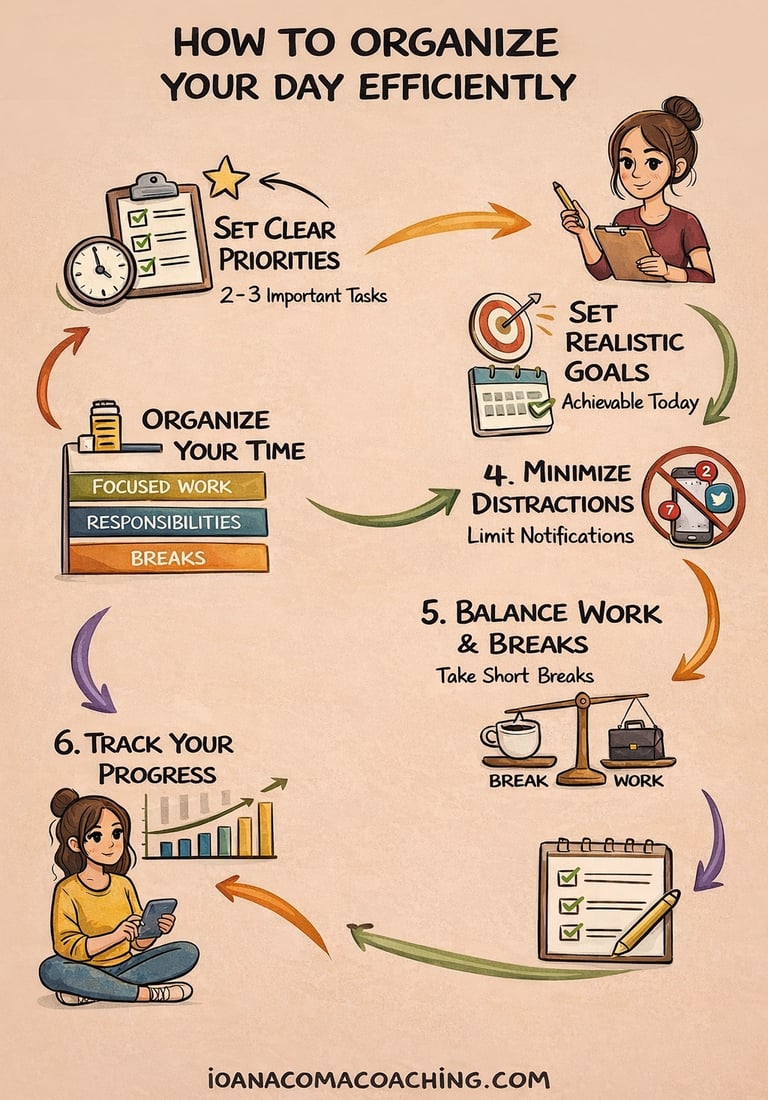
Distractions are one of the biggest drains on your energy, yet they are often underestimated. Your phone, notifications, social media, or even people around you can constantly fragment your attention. Each interruption seems small, but together they destroy your ability to focus deeply.Reducing distractions doesn’t mean isolating yourself completely — it means protecting your attention intentionally. You can set clear time blocks for uninterrupted work, turn off notifications, or delay responding to messages. These small decisions have a powerful impact on your productivity. A well-planned day is not just about what you do, but also about what you choose not to do.
Another essential element, often ignored, is the balance between work and rest. There is a culture of “constant work” that glorifies exhaustion, but the reality is that long-term performance cannot exist without recovery. Your brain needs breaks to function at its best.When you intentionally include pauses in your day, you’re not losing time — you’re restoring your energy. Even short breaks can make the difference between burnout and sustained focus. Balance doesn’t mean working less — it means working smarter. Knowing when to stop, when to breathe, and when to restart. This healthy relationship with work protects you from burnout and allows you to maintain performance over time.
Finally, tracking your progress is what transforms planning from intention into a real system. When you complete tasks and reflect on your day, you begin to see patterns. You notice when you are most productive, what drains your energy, and where your time is lost. This awareness gives you the power to adjust.Without this step, you stay stuck in repetitive cycles without understanding why results don’t improve. But when you track your progress, you become more efficient over time. You build your own system — one that fits your life, not one copied from others. And eventually, this system becomes your support. You no longer rely on motivation or mood, because you have a clear structure guiding you.
A well-planned day is not about rigid control — it’s about intentional direction. It’s about using your time and energy consciously, so your life reflects what truly matters to you. When you start living this way, you don’t just become more productive — you gain clarity, calm, and a deeper sense of purpose.Because in the end, real productivity is not about how much you do, but how aligned your actions are with who you want to become.
If you feel like you need support in becoming more productive, setting clear goals, and building a system that actually works for you, you can book a coaching session here:
https://www.ioanacomancoaching.com/one-coaching-session-1
You can also read the Romanian version of this article here:
https://www.ioanacomancoaching.com/ro/secretul-productivitatii-nu-fa-mai-mult-fa-ce-conteaza
Planning your day effectively is not just a practical skill — it’s a form of respect for yourself and for the direction you want your life to go. Most people live in reaction mode: replying to messages, handling urgent tasks, and getting carried away by whatever shows up. The problem is not that they do too little, but that they spread their energy across too many things that don’t truly matter.That’s why the first real step toward productivity is clarity. When you start your day by consciously defining 2–3 essential priorities, you create a filter. Everything that appears throughout the day goes through this filter: Does this move me closer to my goal or not? This simple shift takes you from chaos into control. You stop reacting to everything and start choosing. And over time, this repeated choice changes not only your results, but your identity — you become someone who leads their life, not someone who is carried by it.
A major obstacle to real productivity is the tendency to overload your day with unrealistic goals. There is constant pressure — sometimes from social media, sometimes from your own expectations — to do as much as possible in as little time as possible. But this approach almost always leads to frustration, exhaustion, and the feeling that you are not enough.The truth is, sustainable progress is not built through bursts of effort, but through consistency. A well-planned day is not packed to the limit — it is balanced. It includes meaningful tasks, but also space for flexibility. Realistic goals challenge you without overwhelming you. They allow you to end your day feeling that you’ve moved forward, not fallen behind. And that feeling matters, because it fuels long-term motivation. Confidence doesn’t come from big promises — it comes from small, repeated proof.
Time management is, in essence, energy management. Many people believe they don’t have enough time, but in reality, the issue is how they distribute their attention. When you divide your day into clear time blocks — focused work, responsibilities, personal time, and rest — you create structure. This structure reduces unnecessary decisions and helps you enter a state of deep focus more easily.Instead of constantly asking yourself, “What should I do next?”, you already have a plan. And that saves mental energy. It also teaches you an important truth: you cannot do everything in one day — and that’s okay. Accepting the limits of your time is a mature step toward a balanced life. Instead of trying to fit everything in, you start choosing what truly deserves your time.


Ioana Coman Coaching
Sessions available online. For inquiries or to book a session, contact me at: ioanacomancoaching@yahoo.com
Follow Ioana Coman Coaching on Instagram: @ioanacomancoaching https://www.instagram.com/ioanacomancoaching/
Ioana Coman Coaching — founded by Ioana Elena Coman