First Coaching Session – €30 (one-time offer)



They didn’t love you. They mirrored you.
RELATIONSHIPS & PSYCHOLOGY
Ioana Coman
3/31/20262 min read
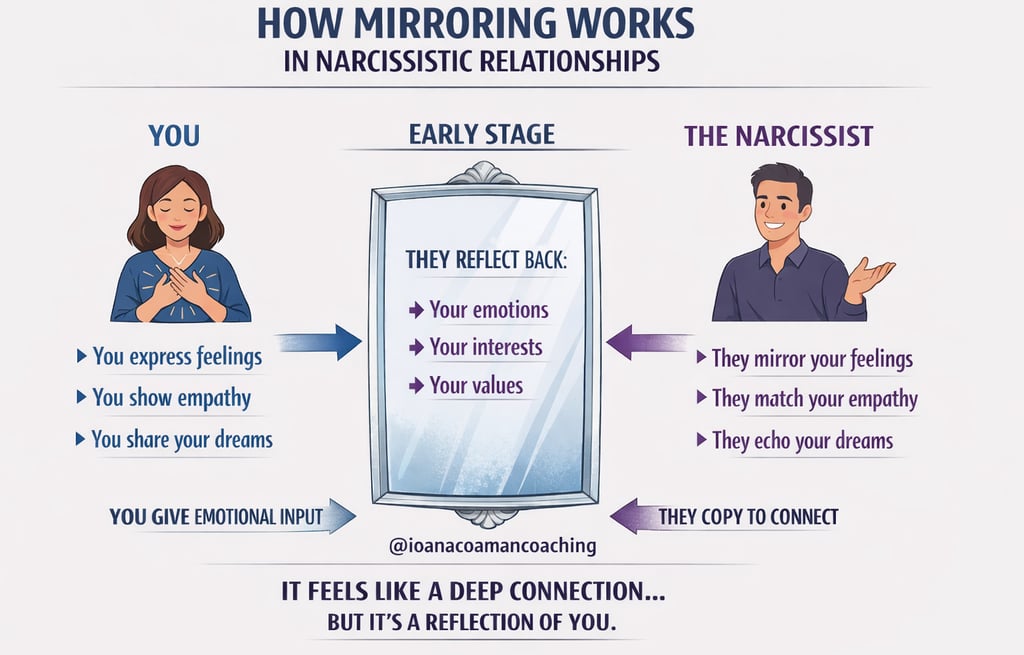
Narcissistic relationship dynamics often become clear when you understand the concept of emotional mirroring. In the early stages, the connection can feel unusually deep, intense, and perfectly aligned. You may feel like you’ve finally met someone who truly understands you—someone who shares your values, emotions, and perspectives almost effortlessly.
But what feels like rare compatibility may not be genuine emotional connection. Psychological research suggests it can be a form of adaptive behavior rather than authentic emotional expression.
Studies on narcissistic traits, including the work of W. Keith Campbell and Joshua D. Miller, show that individuals with higher levels of narcissism often engage in self-enhancement strategies and interpersonal regulation. One of these strategies is mirroring—subtly reflecting your preferences, emotions, and identity back to you in order to create rapid intimacy and attachment.
This aligns with broader findings in social psychology. Research by Tanya L. Chartrand and John A. Bargh demonstrates that mimicry increases liking and perceived connection. When someone mirrors you, your brain interprets it as similarity and safety. You feel seen. You feel understood. You feel connected.
But here’s the key difference:
mirroring creates the feeling of connection—without necessarily creating the substance of it.
The illusion of mutuality emerges because the responses you receive are based on your own emotional input. Your empathy, care, and vulnerability are reflected back to you. This can make the bond feel incredibly strong, even irreplaceable. However, this dynamic depends on a continuous source—your emotional availability. When you begin to:
– set boundaries
– pull back emotionally
– stop over-giving the mirrored behavior often fades. Not because love is disappearing, but because the reflection no longer has as much to copy.
This shift can feel confusing and painful. You may start questioning yourself:
– “What changed?”
– “Was it something I did?”
– “Why aren’t they the same anymore?”
But the answer often lies in the structure of the dynamic itself.
Unlike genuine emotional connection—which involves two people bringing their own internal emotional depth—mirroring relies on external input. Research on narcissistic personality patterns highlights reduced empathy and difficulty maintaining stable emotional reciprocity. This helps explain why the connection may feel intense at first, but inconsistent over time.
Understanding this distinction is powerful.It allows you to reframe the experience—not as a loss of something real, but as the realization that the connection may have been disproportionately sustained by your emotional contribution. In other words: you weren’t receiving something rare—you were experiencing your own emotional depth reflected back to you. And that matters.Because it means your ability to love, connect, and invest deeply is real. The confusion came from believing it was equally generated on both sides.


Ioana Coman Coaching
Sessions available online. For inquiries or to book a session, contact me at: ioanacomancoaching@yahoo.com
Follow Ioana Coman Coaching on Instagram: @ioanacomancoaching https://www.instagram.com/ioanacomancoaching/
Ioana Coman Coaching — founded by Ioana Elena Coman