First Coaching Session – €30 (one-time offer)


Why do we become more attached to the people who hurt us?
RELATIONSHIPS & PSYCHOLOGY
Ioana Coman Coaching
5/28/20263 min read
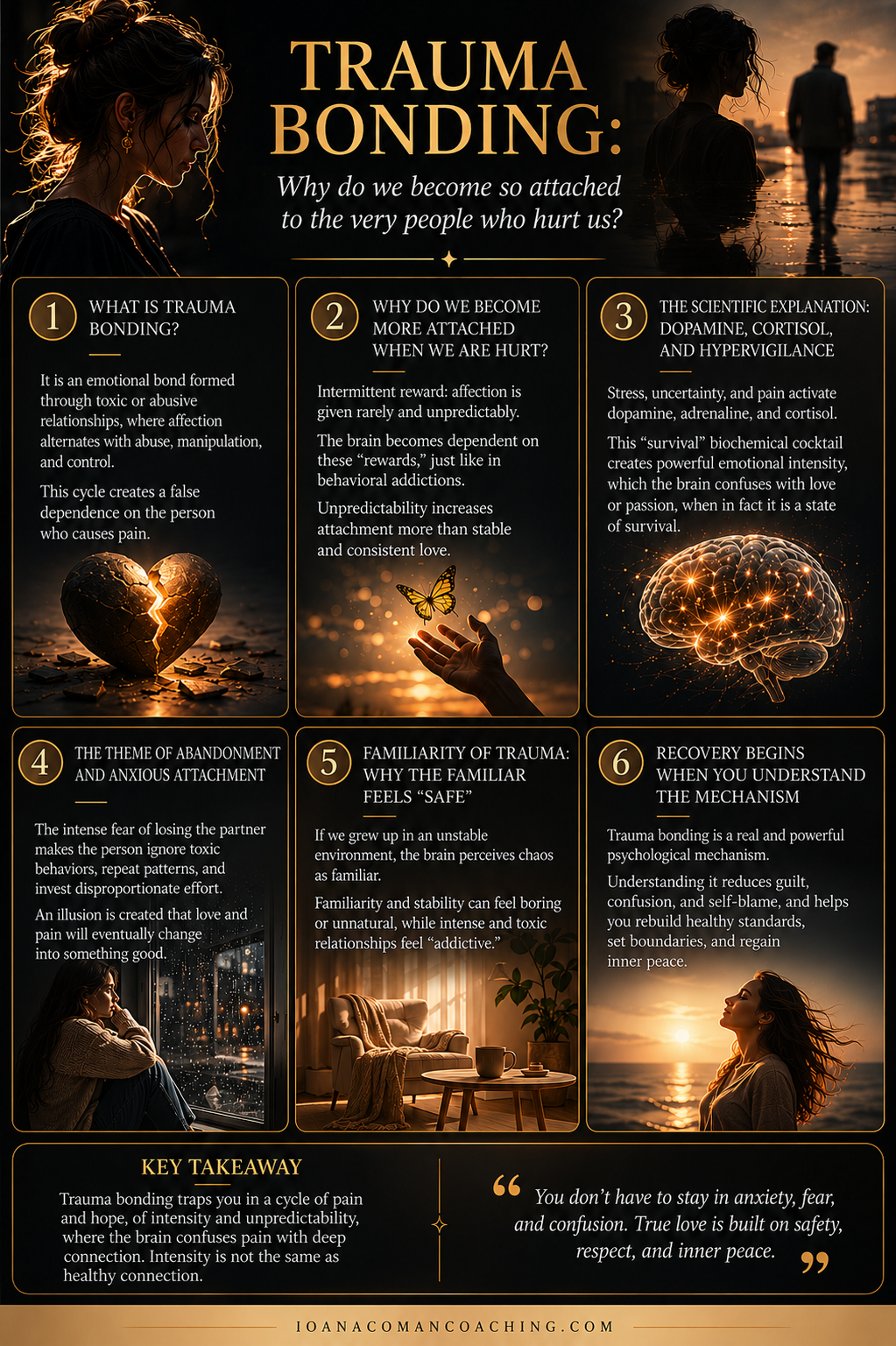

Trauma bonding is a deep psychological and emotional connection that develops in toxic or abusive relationships, where periods of abuse, manipulation, and rejection alternate with moments of apparent affection, closeness, and validation. This cycle creates an extremely strong emotional dependency on the very person causing the pain.
For outsiders, the phenomenon can seem difficult to understand. Many people wonder how someone can remain attached to the person who hurts them the most. In reality, psychology and neuroscience explain this mechanism very clearly. One of the most important psychological explanations is called intermittent reinforcement. Instead of offering consistent affection, the person alternates between moments of closeness and episodes of rejection, criticism, or abuse.
The brain becomes intensely focused on the rare positive moments, which are perceived as a “reward.” Paradoxically, this inconsistency strengthens attachment far more than if the relationship had been consistently positive and stable. The same mechanism appears in behavioral addictions, including gambling. What creates the strongest dependency is not consistency, but unpredictability. The person begins living in a constant state of anticipation and hope, believing that maybe this time things will become good again.
The scientific explanation: dopamine, cortisol, and hypervigilance
On a neurobiological level, traumatic relationships strongly activate the brain’s stress and reward systems. The stress generated by uncertainty and emotional pain triggers the release of dopamine, adrenaline, and cortisol.
This biochemical “storm” creates hypervigilance and intense emotional activation. The brain may begin to confuse this intensity with deep love or passion. In reality, what the person experiences is not always healthy love, but rather a mixture of anxiety, fear of loss, hope, and the need for reconnection. This is why many people describe toxic relationships as “the most intense” relationships of their lives.
Fear of abandonment and anxious attachment
People trapped in trauma bonds often develop an anxious attachment style. Their intense fear of losing the partner causes them to tolerate behaviors they normally would never accept.
The person starts over-explaining, repeatedly forgiving, investing disproportionately in the relationship, and believing that if they love enough, the relationship will eventually change. An illusion develops that the relationship can be saved solely through more patience, love, and understanding from the victim.
In reality, this ongoing emotional investment often deepens the dependency even further.
Trauma familiarity: Why calm relationships can feel “boring”
In psychology, this phenomenon is sometimes referred to as traumatic repetition. If a person grew up in an environment where love was associated with instability, criticism, rejection, tension, or anxiety, the brain begins to perceive these dynamics as familiar.
As a result, calm and healthy relationships may initially feel lacking in passion, too quiet, or even “boring.” A nervous system accustomed to chaos may interpret calmness as unfamiliar or emotionally empty. Meanwhile, toxic relationships constantly activate adrenaline and anxiety, creating the false sensation of “extraordinary love.”
Why is it so difficult to leave a toxic relationship?
An important aspect is that traumatic relationships are not negative all the time. If they were only painful, most people would leave much sooner.
There are also moments of tenderness, closeness, passion, validation, and emotional connection. These moments are precisely what maintain hope and attachment.
The person stays not only because of what the relationship currently is, but also because of what it once was, what it could become, and the emotional promise represented by the good moments.
What does healthy love look like?
One of the most important realizations in the healing process is understanding that healthy love should not constantly produce anxiety, fear, and emotional survival mode.
Healthy relationships are not perfect, but they are built on safety, respect, emotional regulation, goodwill, and the absence of intentional emotional destruction.
In healthy relationships, people can experience conflict and disagreement without humiliation, manipulation, aggression, or constant psychological warfare. There is dialogue, self-regulation, and a genuine desire not to harm the other person.
Healing begins when you understand the mechanism
A crucial moment in healing is realizing that intense attachment does not automatically mean healthy love.
Many people remain trapped in toxic relationships for years because they confuse emotional dependency with deep love. Understanding the mechanism reduces shame, self-blame, and confusion. The person begins to realize they were not “weak,” but caught in an extremely powerful psychological mechanism.
Trauma bonding is one of the strongest and most confusing forms of emotional attachment. Relationships based on alternating pain and reward can create extremely intense emotional addictions that are very difficult to break.
One of the most important psychological lessons is that intensity does not automatically equal healthy love. Healthy love should not make you live in constant anxiety, fear, hypervigilance, and confusion. Healthy relationships are built on emotional safety, respect, and inner peace — not emotional survival and fear of abandonment.
Book a 1:1 coaching session here:
Ihttps://www.ioanacomancoaching.com/one-coaching-session-1
to discover the foundations of healthy relationships and learn how to break the emotional patterns that keep you stuck in toxic relationships, anxiety, and emotional dependency.


Ioana Coman Coaching
Sessions available online. For inquiries or to book a session, contact me at: ioanacomancoaching@yahoo.com
Follow Ioana Coman Coaching on Instagram: @ioanacomancoaching https://www.instagram.com/ioanacomancoaching/
Ioana Coman Coaching — founded by Ioana Elena Coman